

The agency sends over the monthly report. Numbers everywhere. Clicks are up. Impressions are up. The campaign, they say, is performing incredibly well.
You open your banking app. Nothing’s changed.
This scene plays out every month across Brunei — in clinics in Kiulap, F&B businesses in Gadong, construction firms in Seria, and e-commerce brands shipping across the country. The reports look impressive. The revenue doesn’t move.
The problem isn’t the ads. It’s what gets measured.
In 2026, the era of vanity metrics is done. True performance marketing is about closed-loop reporting — connecting every dollar of ad spend directly to the revenue it generates, tracked through your CRM and a unified data system. If your marketing partner can’t show you that chain of evidence, they’re spending your budget on beautiful guesswork.
The Numbers That Were Never Real Numbers
Let’s be clear about something: impressions, page views, and click-through rates are activity metrics. They tell you something happened. They don’t tell you if it mattered.
Think of it this way. Imagine you opened a kedai and hired someone to hand out flyers. They come back and say, “Great news — 3,000 people took a flyer.” But you ask: how many walked in? How many bought something? Silence. That’s the vanity metrics problem, just dressed up in a digital report.
The situation has gotten harder to navigate. Privacy laws across the region have tightened what platforms are allowed to track. And AI-powered search features now answer people’s questions directly on Google — meaning a portion of your potential customers never even clicks through to your website.
So when a campaign reports 50,000 impressions and a 3% click rate, what does that actually prove? That roughly 1,500 people may have clicked. Not who bought anything. Not how much revenue came back.
This is why forward-thinking businesses are shifting toward Revenue Operations — the practice of connecting your marketing data, sales records, and customer information into one unified view, so you stop making decisions in the dark.
Closed-Loop Reporting: Plain and Simple
Closed-loop reporting sounds technical. The idea behind it isn’t.
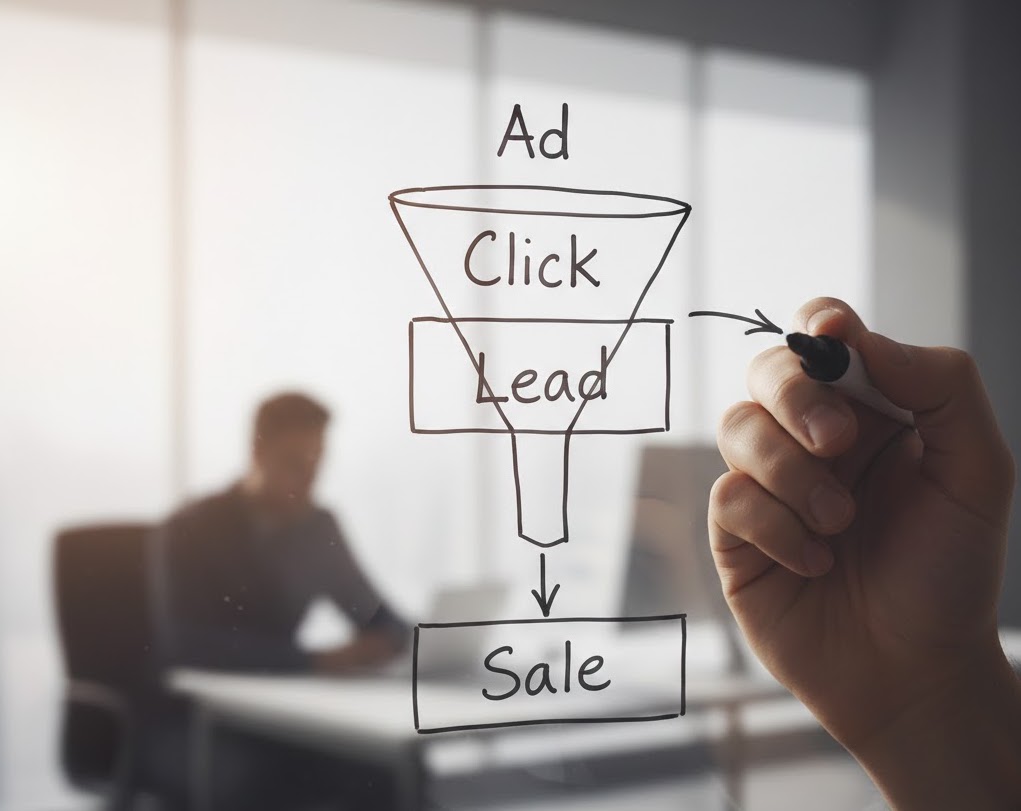
It means tracking a customer from the very first time they see your brand — a Facebook ad, a Google result, an Instagram post — all the way through to when they actually pay you money. And then feeding that information back into the system, so your campaigns learn what a real customer looks like.
Here’s a simple version of how it works:
- Someone in Brunei sees your Google Ad and clicks it
- They fill in your contact form — your system notes which ad brought them there
- Your team follows up and closes the sale — that revenue is recorded against the same customer
- That “this ad led to a sale” data goes back to Google → the campaign now targets people who are more likely to buy, not just click
The whole chain only works if your ad platforms and your customer management system (CRM) are connected. That connection requires APIs, proper tracking setup, and clean data hygiene — the kind of technical groundwork most traditional agencies don’t build, because it goes beyond running ads.
At Digital Sage, building that infrastructure — the integrations, the dashboards, the data pipelines — is core to how we work. It’s what separates a marketing system from a marketing expense.
The 4 Numbers Your Dashboard Should Actually Show
Stop watching impressions. Start watching these:
1. CAC — Customer Acquisition Cost
This is the real cost of getting one new paying customer. Not just your ad spend. The full picture includes:
- Your advertising budget (Meta, Google, TikTok, etc.)
- Agency or team fees for that period
- Software costs — your CRM, your landing page tool, your scheduling platform
- Any photography or creative production costs
Add all of that up and divide by the number of new customers you gained that month. That’s your true CAC. Many business owners are surprised when they calculate this properly for the first time.
2. LTV — Customer Lifetime Value
One sale is rarely the whole story. LTV is how much a customer is worth to your business over their entire relationship with you — repeat purchases, referrals, upsells included.
For a Brunei beauty clinic, a patient who comes in for one treatment and becomes a regular is worth significantly more than their first appointment. Optimising for single transactions while ignoring that bigger number means leaving money on the table every time.
3. Lead-to-Customer Conversion Rate
This tells you where your funnel is leaking. If you’re generating 200 leads a month but only closing 8 of them, the answer isn’t always “run more ads.” More often, the question is: what’s happening to the other 192?
Tracking this at each stage — from first contact to consultation to closed deal — shows you exactly where the drop-off is.
4. True ROAS — Return on Ad Spend
ROAS simply means: for every dollar spent on ads, how much came back in revenue?
But here’s the catch: platform-reported ROAS is not true ROAS. Google and Meta both use their own attribution models, which often overcount conversions. True ROAS is calculated from your CRM — actual closed revenue divided by actual ad spend. That’s the only number worth presenting to a business owner.
A healthy growth ratio to aim for is an LTV:CAC of 3:1 or 4:1. If it costs you BND 500 to acquire a customer who brings in BND 600 over their lifetime, that math doesn’t sustain a growing business — no matter how good the campaign looks on paper.

The Quiet Killer: Your Website
Here’s a situation that plays out more than most people realise.
You have a well-targeted ad campaign. The audience is right. The copy is working. The budget is sensible. But your website takes five seconds to load on mobile. Your contact form has eight fields. The page layout looks like it hasn’t been updated since 2019.
Every one of those friction points is costing you customers — and they’re showing up in your Cost-Per-Acquisition without it being obvious why.
For SMEs in Brunei, this is especially common. The business invests in advertising but hasn’t updated the website in years. Or the site looks good on a desktop but breaks on a phone — which is how most people in Brunei browse. The ad spend goes in. The conversions don’t come back.
Website performance is a direct multiplier on your ad ROI. Fixing a slow, confusing website often delivers faster ROI improvement than months of campaign adjustments. It’s one of the first things we look at — alongside the ad accounts and CRM setup — because they all affect the same number.
That’s also why rapid web development and low-code builds are part of what we offer. Not as a separate product, but because they’re often the missing piece in a marketing system that isn’t converting.

Marketing Without a System Is Expensive Guessing
Here’s the honest version of where most Brunei businesses are right now: they’re spending on ads, posting content, and maintaining a website — but none of it is connected. There’s no way to know which activity drove which result.
That’s not a marketing problem. That’s an infrastructure problem.
Closed-loop reporting fixes it by connecting your ad platforms to your CRM, your CRM to your sales records, and your sales records back to your campaign budgets. It turns marketing from a cost you hope is working into a system you can measure, adjust, and scale.
The businesses that will grow confidently over the next few years — whether they’re clinics, construction firms, F&B concepts, or local e-commerce brands — are the ones building this foundation now. Not chasing the next platform or posting trend. Building systems that connect their marketing spend to real, trackable outcomes.
That’s what first-party data ownership means in practice: you’re not dependent on Meta or Google to tell you what worked. Your own infrastructure tells you.
Are your ad platforms and CRM actually connected? If you’re getting monthly reports full of impressions and click rates but can’t trace those clicks to actual sales — that’s exactly the gap we’re built to close.
Contact Digital Sage Agency for a custom AI marketing dashboard and tech-stack audit. We’ll show you what your marketing is actually doing — and what it should be doing instead.
Digital Sage Agency | Marketing and tech under one roof — built for Brunei, built to scale.